Podcasts
English I Deutsch
Podcast: "At the Push of a Button – 3D Printing
for the Society of Tomorrow"
How is 3D printing changing the way we manufacture, learn and develop new solutions for medicine and society?
In our five-part German-language podcast series “Auf Knopfdruck – 3D-Druck für die Gesellschaft von morgen” (“At the Push of a Button – 3D Printing for the Society of Tomorrow”), science journalist Isabelle Rogge talks to researchers and experts about the technologies, applications and societal implications of 3D printing.
The podcast explores different aspects of 3D printing and additive manufacturing – from the technologies behind 3D printing and its use in makerspaces and education to applications in medicine and questions of sustainable manufacturing.
The podcast was created in collaboration between the Cluster of Excellence 3D Matter Made to Order (3DMM2O) and the Institute for Technology Assessment and Systems Analysis (ITAS) at Karlsruhe Institute of Technology (KIT).
The podcast is recorded in German. All five episodes are available on YouTube with English subtitles.
.elementor-accordion .elementor-accordion-item:first-of-type {
display: none;}
.elementor-accordion {
  border-top: 1px solid  #D4DFF2C7;
}One Term, Many Technologies I Ein Begriff, viele Technologien
What exactly is 3D printing? This episode explores the many technologies behind the term and their role in society.
Watch Episode 1 on YouTube with English subtitles.
Was steckt eigentlich hinter dem Begriff “3D-Druck”? Diese erste Folge stellt die verschiedenen Technologien und Verfahren vor, die sich dahinter verbergen, und fragt nach ihrer Rolle in der Gesellschaft.
Wissenschaftsjournalistin Isabelle Rogge spricht mit Martin Wegener, Sprecher des Exzellenzclusters 3D Matter Made to Order (3DMM2O), und Andreas Lösch, Projektleiter im Exzellenzcluster.
You are currently viewing a placeholder content from Default. To access the actual content, click the button below. Please note that doing so will share data with third-party providers.
More Information3D Printing in Makerspaces and Fab Labs I 3D-Druck in öffentlichen Werkstätten
How is 3D printing used in makerspaces and Fab Labs? This episode explores how open workshops make digital fabrication accessible to a wider community.
Watch Episode 2 on YouTube with English subtitles.
Diese Folge blickt in öffentliche Werkstätten, sogenannte FabLabs oder Makerspaces, in denen Bastlerinnen und Tüftlerinnen kreative Projekte verwirklichen.
Wissenschaftsjournalistin Isabelle Rogge spricht mit Philipp Brenner (ZEISS Makerspace @ KIT) und Gerd Keller (FabLab Karlsruhe) über “Making” und wie 3D-Druck dabei eingesetzt wird.
You are currently viewing a placeholder content from Default. To access the actual content, click the button below. Please note that doing so will share data with third-party providers.
More Information3D Printing in Education I 3D-Druck im Bildungssystem
What role can 3D printing play in education? This episode looks at how additive manufacturing supports new approaches to teaching and learning.
Watch Episode 3 on YouTube with English subtitles .
In dieser Folge geht es um den 3D-Druck in Schulen und Universitäten – wie er gelehrt wird und wie damit gelernt wird.
Wissenschaftsjournalistin Isabelle Rogge spricht mit Dr. Enrico Lemma und Dr. Simon Hassemer (Zentrum für Schulqualität und Lehrerbildung Baden-Württemberg) über Projekte und Erfahrungen mit 3D-Druck im Bildungssystem.
You are currently viewing a placeholder content from Default. To access the actual content, click the button below. Please note that doing so will share data with third-party providers.
More Information3D Printing in Medicine and Bioprinting I 3D-Druck in der Medizin
How can 3D printing contribute to personalized medicine? This episode explores bioprinting and personalized prostheses and their potential for future healthcare.
Watch Episode 4 on YouTube with English subtitles.
Diese Folge blickt auf ein Feld mit großen Hoffnungen für die Zukunft der Gesundheit: den Einsatz von 3D-Druck in der Medizin. Werden Behandlungen dadurch individualisierter – und werden wir eines Tages Organe “auf Knopfdruck” herstellen können?
Isabelle Rogge spricht mit Prof. Dr. Ute Schepers (Karlsruher Institut für Technologie) und Dr. David Seibt (TU Berlin) über die Möglichkeiten des 3D-Biodrucks und individualisierte Prothesen als Akt der Selbstermächtigung.
You are currently viewing a placeholder content from Default. To access the actual content, click the button below. Please note that doing so will share data with third-party providers.
More Information3D Printing and Sustainability I 3D-Druck und Nachhaltigkeit
Can 3D printing contribute to more sustainable manufacturing? This episode explores local production, new materials and more resource-efficient processes.
Watch Episode 5 on YouTube with English subtitles.
In der letzten Folge geht es um Chancen und Herausforderungen,
die 3D-Druck für eine nachhaltigere Produktion bietet: Führt lokales Drucken zu
mehr Regionalisierung? Und welche Innovationen braucht es, damit dabei nicht
noch mehr Wegwerfplastik entsteht?
Moderatorin Isabelle Rogge spricht mit Clara Vazquez-Martel
(Universität Heidelberg) und Ulrich Petschow (IÖW Berlin) über
Nachhaltigkeitspotenziale des 3D-Drucks – und faszinierende Entwicklungen wie
Sonnenblumenöl als Tinte.
You are currently viewing a placeholder content from Default. To access the actual content, click the button below. Please note that doing so will share data with third-party providers.
More Information
More Podcasts Featuring 3DMM2O Research
Podcast Series „Exzellent erklärt – Spitzenforschung für alle”
The German science podcast “Exzellent erklärt – Spitzenforschung für alle” presents research from Germany’s Clusters of Excellence and makes current scientific topics accessible to a wider audience.
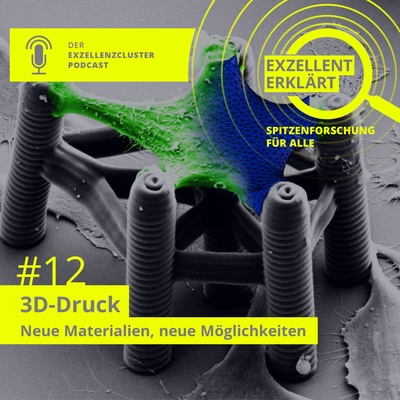
In this episode, researchers from the Cluster of Excellence 3D Matter Made to Order (3DMM2O) provide insights into two different areas of research: organoids and metamaterials.
Jochen Wittbrodt and Christina Schlagheck discuss research on organoids – artificially produced, organ-like cellular structures – and their potential applications. Peter Gumbsch introduces research on metamaterials with specifically designed properties and discusses how these materials could contribute to more sustainable technologies.
The podcast is recorded in German. Listen to the German audio here, or watch it on YouTube with English subtitles.