
Research Area D: Digital Blueprints
We develop theoretical concepts and computational tools to generate digital blueprints for 3D-printed materials and devices, merging physics, data, and AI.
Our research advances the digital design of 3D-printed materials and devices, with the long-term goal to tailor their properties on demand. By combining advanced physics-based models, machine learning, and data-driven strategies, we generate blueprints that quickly can be turned into physical reality by 3D-printing. Collaborating across disciplines, we address challenges from multi-scale modeling to inverse design, enabling breakthroughs in photonics, acoustics, active soft matter and bio-inspired systems. This work accelerates innovation in fabrication and characterization, driving a new era of smart materials and transformative applications. The two Sub-Areas of Research Area D distinguish themselves through physics-based approaches (D1) and data-based approaches (D2).
Physics-based Approaches (D1)
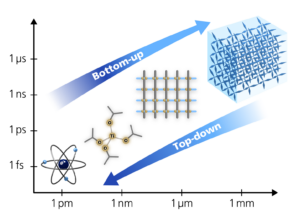
Sub-Area D1 exploits model driven approaches to study on theoretical and computational grounds scientific and engineering challenges that revolve around 3D nanoprinting. This concerns the description of the functionality across all the length scales that matter in such materials but also the design and specifically the inverse design of devices.
Related Lighthouse Projects:

Data-based Approaches (D2)
Sub-Area D2 pursues data-driven research activities that leverage machine learning to accelerate physics-based simulations, data analysis, and decision-making in automated high-throughput laboratories. Our efforts focus on three tightly coupled directions: AI-enabled materials acceleration platforms, physics-informed machine learning, and ML approaches for bridging length and time scales.
Related Lighthouse Projects: