Electro-optic Devices for Future Optical Communications
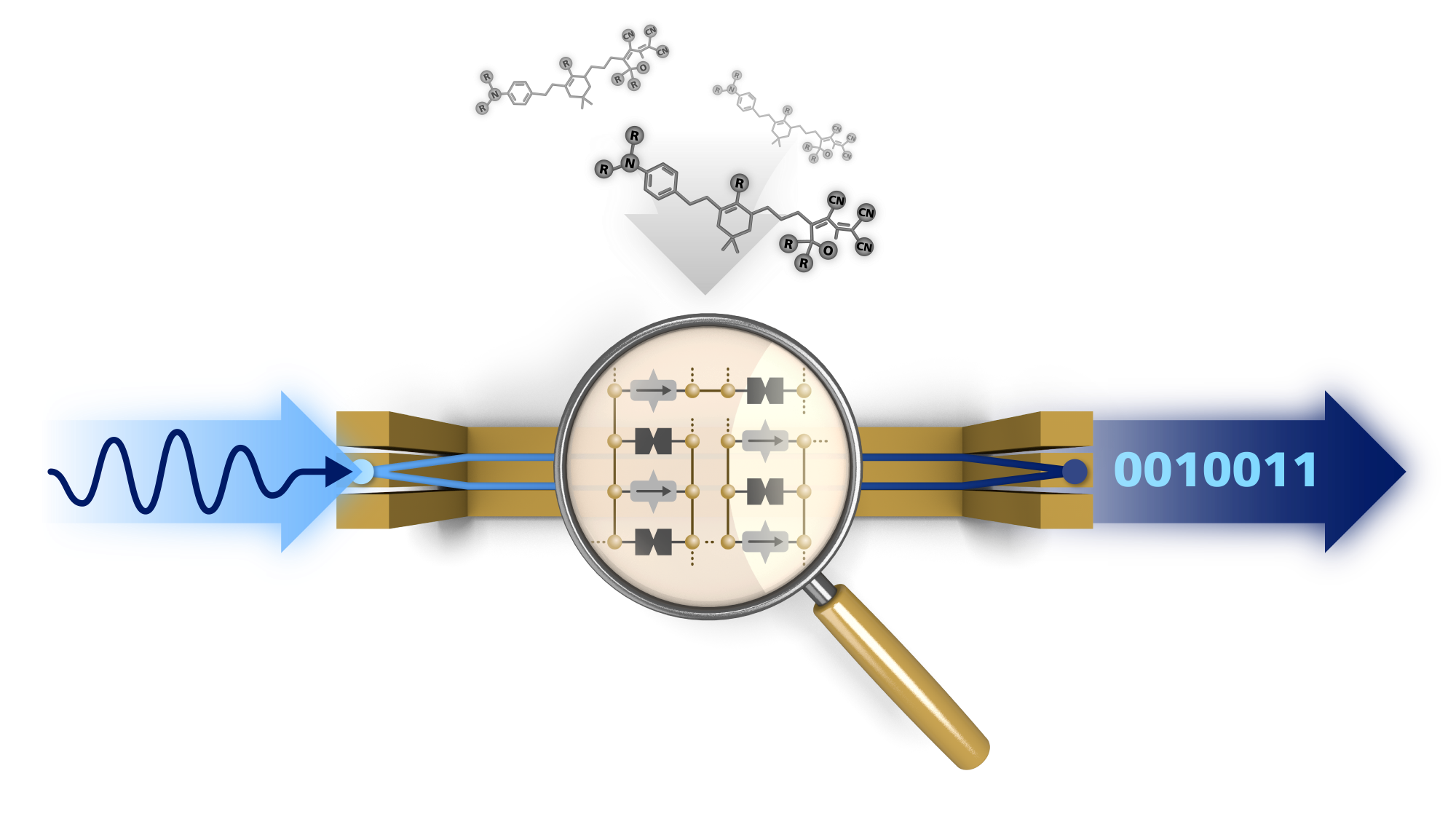
The combination of organic EO materials with silicon photonics offers a promising path towards highly efficient SOH modulators.
Click on the images to enlarge them and view the source.
Our Goal
Traditionally, efficient organic dyes for such modulators have been developed by designing donor–π–acceptor structures that exhibit high molecular hyperpolarizabilities (β), high glass transition temperatures (Tg), and the ability to form acentric alignment via electric-field poling. While these materials offer excellent EO performance, their long-term application has been limited by thermal and photochemical stability issues and the maintenance of their alignment. To overcome this, recent approaches regarding the design of dyes focus on increasing chemical stability by introducing novel π–bridges that enhance thermal and photochemical robustness without sacrificing the hyperpolarizability.
In Lighthouse Project 5, we simultaneously aim to optimize hyperpolarizability through precise molecular design, enhance thermal and photochemical stability, and implement post-poling crosslinking. This process will be guided by theoretical modeling to ensure an efficient optimization process. Furthermore, customized host materials for the organic dyes will be synthesized to create host-guest systems that enhance thermal and photochemical stability while also supporting the acentric alignment of the dyes. For the long-term stability of this alignment, different crosslinking strategies will be employed to prevent the EO material from realigning.
By bringing together engineers, physicists, chemists, and theorists in the cluster of excellence 3DMM2O, Lighthouse Project 5 sets the stage for the next generation of ultra-fast and sustainable communication.
Principal Investigators Involved
Jasmin Aghassi-Hagmann Karlsruhe Institute of Technology (KIT)