Research Program
The vision of the Cluster leads to our Research Program which is formally structured in four Research Areas, which are each subdivided into two Sub-Areas and further organized into Projects and Lighthouse Projects.
The Cluster of Excellence 3D Matter Made to Order combines the research competencies of KIT and Heidelberg University, bringing together researchers and creating innovation and synergies in an enriching environment.
Seizing the complementary strengths of the two universities, the Cluster pursues a highly interdisciplinary approach combining natural and engineering sciences. This means that the 42 Principal Investigators of the two universities bring together a wide variety of scientific backgrounds, ranging from biology, chemistry and physics to engineering and materials science.
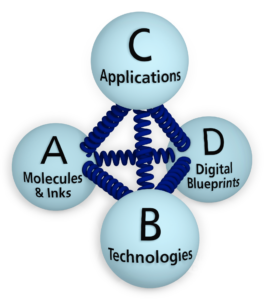
The structure of four Research Areas, each of which is comprised of two Sub-Areas and coordinated through Projects and Lighthouse Projects, matches the vision of the Cluster as it represents the interconnected elements required for scalable digital 3D Additive Manufacturing.
Research Area Molecules & Inks (A) focuses on designing and programming molecular building blocks such as inks and resists. Research Area Technologies (B) is concerned with advancing 3D Additive Manufacturing in terms of spatial resolution, speed, scalability, and multi-material processing. Together, these two areas provide the material and technological basis of the Cluster. Research Area Applications (C) builds on this foundation to realize functional devices and systems in materials science and the life sciences. Research Area Digital Blueprints (D) complements this framework by developing physics-based and data-driven approaches for modeling, simulation, and data analysis. These approaches enable the predictive and data-guided design of materials, processes, and applications.