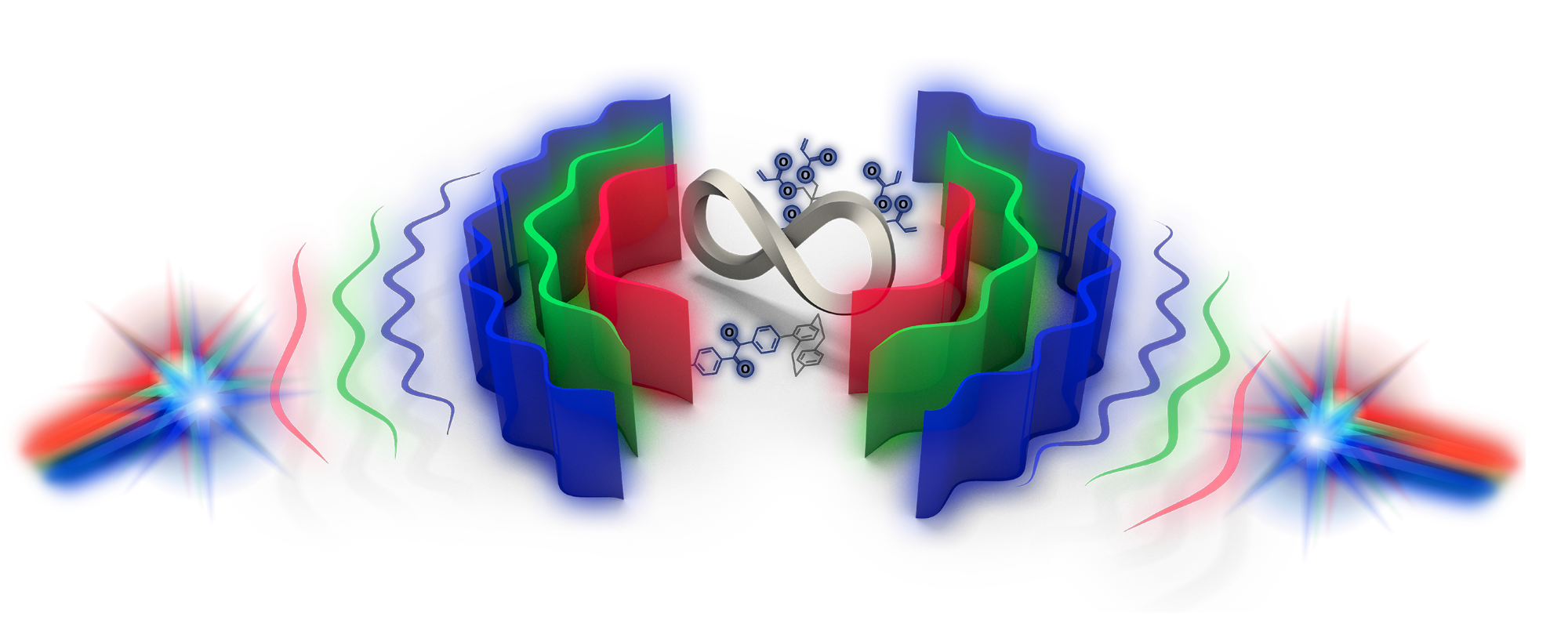
LP1 explores holography using light for ultrafast 3D nanoprinting and ultrasound for 3D cell assembly.
Click on the images to enlarge them and view the source.
Our Goal
This Lighthouse Project aims at establishing massively parallel holographic 3D printing. We pursue both, using electromagnetic waves (light) and ultrasound waves.
For light, holograms will be realized by static/dynamic phase masks, diffractive optical elements, or optical metasurfaces. Some of these can be realized by 3D laser nanoprinting. To expose a volumetric structure by the 3D light field that results from a plane-wave passing through this hologram, theory needs to solve an inverse problem to compute the hologram – a first challenge. A physics challenge lies in realizing the holograms with sufficient accuracy. A chemistry challenge lies in that the exposed two-photon photoresist needs to be sufficiently sensitive such that the energy of a single optical femtosecond suffices to polymerize the entire volume of the structure. We expect that deep sub-µm voxel sizes can be 3D printed at peak rates exceeding 1020 voxel/s – many orders of magnitude faster than the current state-of-the-art of 108 voxel/s.
For ultrasound, the physics is analogous. Using static ultrasound holograms, forces have already been exerted onto larger entities such as biological cells, which can thereby be assembled into organoid-like architectures. A theory and physics challenge now lies in realizing dynamic ultrasound holograms. Thereafter, flexible “single-shot” 3D assembly of biological structures with overall dimensions up to one centimeter appears to be in reach.